My Stammbaum

I am a  fifth generation German American on my father’s side, a descendant of Michael Harm (born 1841) in Freinsheim, Germany. Across the Atlantic, still in Freinsheim, dwell descendants of Michael’s brother Philipp Harm (born in 1839). How do we keep track of who is related to who?

One way is through a web site that allows us to keep track of family trees. One day in my email inbox, I received an invitation to join Verwandt, where a relative of mine in Germany had entered much of his family tree data, including pictures. Via this invitation, I was able to see what he had done and add information of my own. Hence together, we are building a Stammbaum, a family tree, of the descendants of the two brothers. The web site can be viewed in either English or German, although its first language is German and not everything translates. There is the opportunity to load photos, dates of birth and death, maiden names, etc.

There is an English language version of this program now working in collaboration with Verwandt called My Heritage. These kinds of sites allow family members to compile data even as we’re scattered to the four corners of the Earth. Like family reunions without jet lag, and no macaroni salad.

Spring cleaning

I know I’m tapping into my German heritage on days like today — I’m cleaning. One of my earliest memories is of my grandmother with her bucket, soapy water and soft cloth washing chairs, counters, tight corners, everything within reach. As she cleaned, she often wore an apron and a cap.

I’m not only German–on my mother’s side, I’m Scottish. From the looks of my ancestors on this side of the family, they weren’t neat and tidy types, having a tendency to run barefoot with hair unkempt, allowing things to get really messy before straightening up.

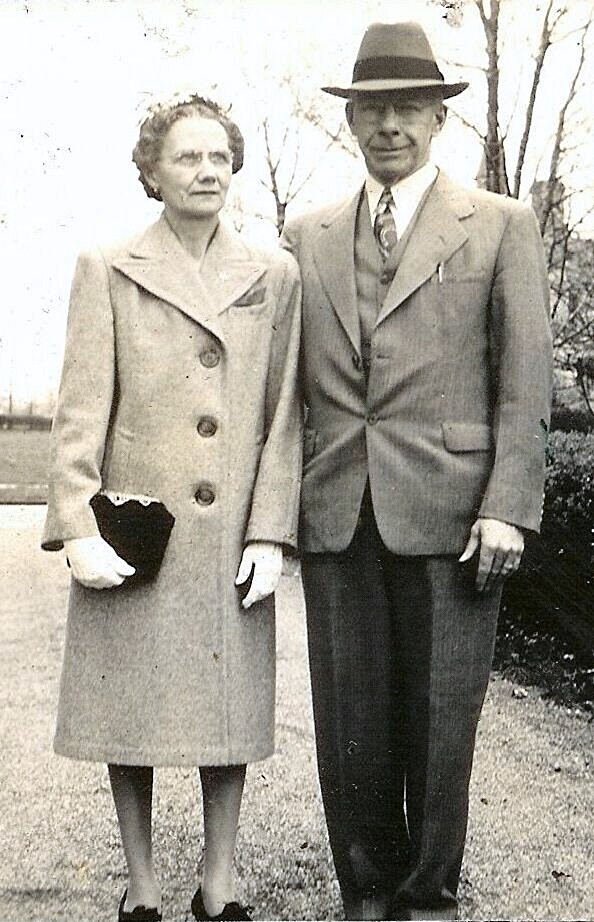
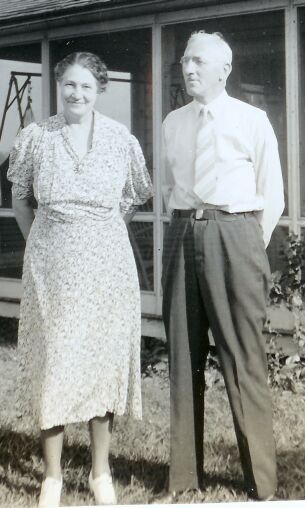
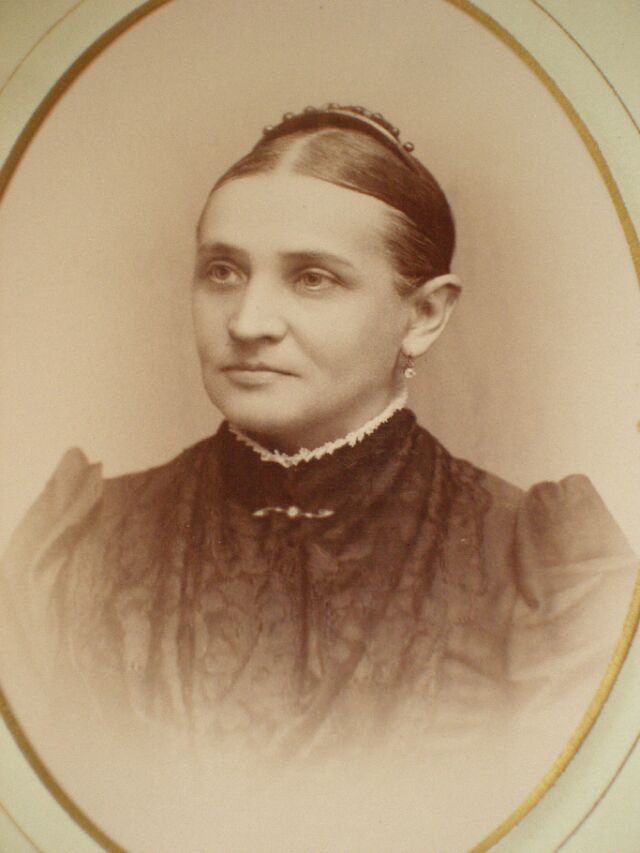
Here are my paternal and maternal grandparents, side by side, prim vs. practical, proper vs. well, pleasant.

I’m driven to clean, and I’m as grumpy as my grandmother Emma when I have to do it. But it’s only temporary. Afterwards, in a clean house, you’ll find me beaming like Grandmother Mary.

Great books about immigrants

There are some great novels out there, historical fiction about immigrants — I’ll add to this list as I go along. Here are just a few I’ve come across:

Accordion Crimes by E. Annie Proulx

Blindspot by Jane Kamensky and Jill Lepore

Away by Amy Bloom

Can you recommend others?

Another research read: The Last of the Mohicans.

Why? First, let me say Mark Twain’s derision and mockery of James Fenimore Cooper’s writing style has some merit. (See Twain’s The American Claimant.) Cooper does a terrible job with women, not to mention secondary characters in general, who drop out and reappear at the author’s convenience. Nevertheless, the book Pfälzer in Amerika notes that Cooper’s Hawk-eye was modeled after Johann Adam Hartmann, an immigrant from the Palatinate (same area as my greatgreatgrandfather) who fought on the colonists’ side in the Mohawk Valley Indian uprising of 1777. “[Hartmann’s] sure aim and his vigilance saved the lives of many of his fellow countrymen. With poetic licence James Fenimore Cooper, Hartmann’s neighbour, incorporated much of the life story of this Indian fighter in his The Last of the Mohicans.” (p.60)

Mohicans was a quick read, and impressed me again how 80 years later, in 1857, when my greatgreatgrandfather arrived in Ohio, that style of life was already ancient history.

Working hammersmith

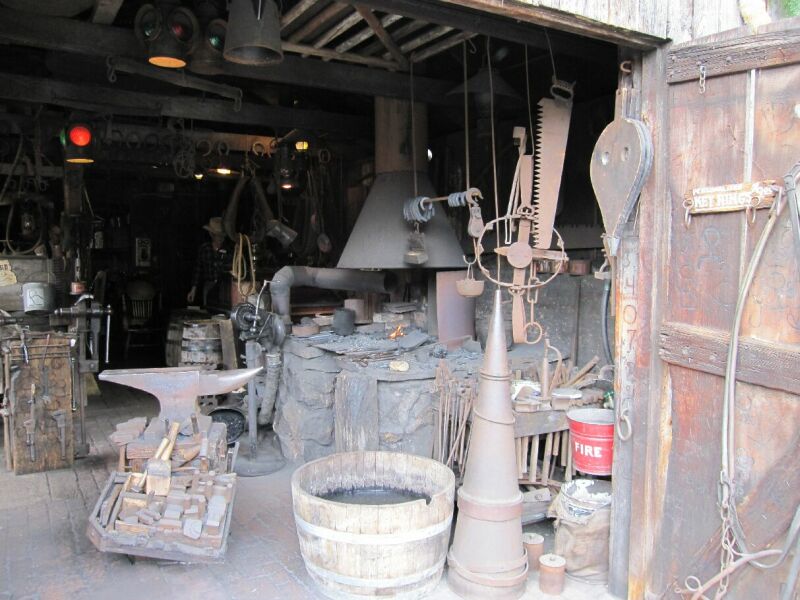
I took a trip to Knott’s Berry Farm with my teens and hung around the Ghost Town blacksmith shop like some kind of history geek.

The shop was operating, so we saw a demonstration, and heard a spiel, during which I learned the origins of two colloquial expressions.

“Too many irons in the fire” comes from the fact that blacksmiths used to put a piece of iron in their fire to cool it down quickly. So too many irons in the fire will render your fire useless.

“Beat the daylights out of” — in the photo at right, two anvils are pictured. The standard one on the left looks like a Wright or a Hay Budden. The one on the other side of the water barrel is called a “cone anvil.” It was used to make perfectly circular rings. The standard anvil’s horn makes an oval shape, so once a ring was pounded to approximate size, the blacksmith would transfer it to the cone anvil to form it into a perfect circle. They’d beat the ring down on the cone until no daylight was showing, thus beating the daylights out of it.

Wiener Schnitzel revelation

The Wiener Schnitzel legacy

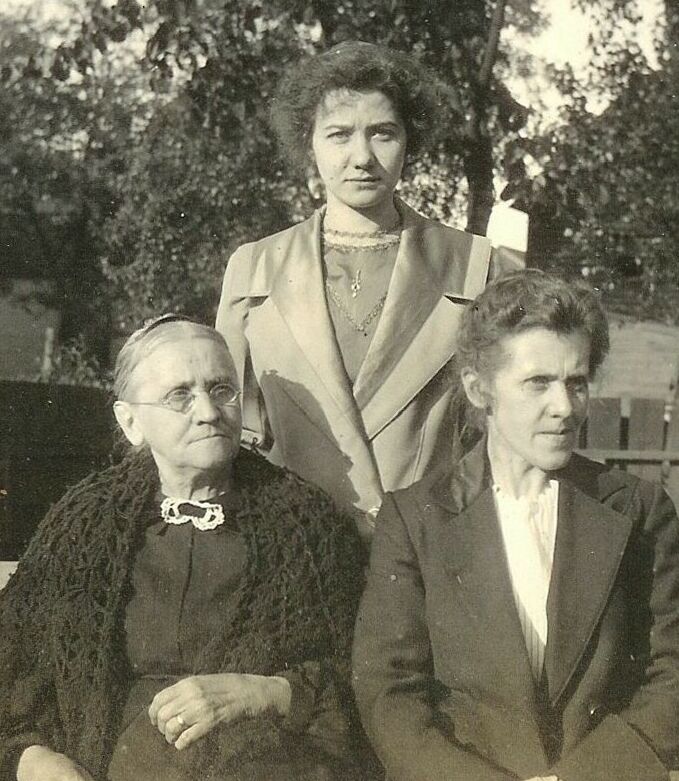
My grandmother Emma (center back in the photo) knew Michael Harm. He died when she was around nine years old. Grandmother used to tell me stories about him, how her grandfather suffered from gout at the end of his life, how he’d sit in the kitchen with stiff, swelling joints, her grandmother Elizabeth lining hot cloths along his legs to ease the pain.

My grandmother spent so much time with her grandparents, who still spoke German in their home, that she learned to speak German as a child.

This branch of the family tree, of my father’s maternal lineage, works out to five generations of separation. Michael and Elisabeth Harm (nee Crolly) begat Lucy Harm who begat Emma Hoppensack who begat Clyde Patterson who begat Claire Gebben. You see the first three generations pictured together here.

When growing up, I spent quite a bit of time with my grandmother. Now that I’m writing this thesis, I see those hours in a new light. I keep wondering: What uniquely German traits were passed to my grandmother via her German heritage? What habits? What ethics and ideas? What recipes? Ah, now we’re getting somewhere. The Wiener Schnitzel revelation.

In 1988, I traveled to Europe for a month, which included plans to visit Freinsheim. My work associate at the time had immigrated to the U.S. from Crailsheim in the Schwabian region. As luck would have it, Inge was planning to visit her mother in Crailsheim while I would be traveling in Germany. She invited me to stop in at her mother’s home. “She’ll make her Wiener Schnitzel for you,” my co-worker said. “It’s really great.”

I readily agreed, saying I’d never tried it before. So one evening in May of 1988, during my travels between Berlin and Freinsheim, I found myself sitting in the kitchen of my co-worker’s mother in Crailsheim, watching her put the finishing touches on her signature dish. At that moment, it dawned on me I’d been eating Wiener Schnitzel my whole life. I just knew it by different name: Pork Chops. My grandmother had instructed me, step by step, with great seriousness, on how to prepare what I now understand was an old German family recipe.

Harm family Wiener Schnitzel

4 pork chops (1/2-inch thick slices, bone in is best)

1/4-cup flour

salt and pepper to taste

1/2-1 onion, sliced in rings

1 T. butter or margarine

Toss the 1/4-cup flour with the salt and pepper on a plate and dredge each pork chop in the flour until all sides are completely coated.

Melt the tablespoon of butter or margarine on med-high heat in a fry pan (large enough to hold four pork chops at once). Add the sliced onion, brown for 2-3 minutes. When onions are getting soft, push them to the sides and put the flour-coated pork chops in the bottom of the pan. (Add more butter if the fry pan is too dry.) Brown the pork chops on med-high heat for 5 minutes per side. When the second side is good and brown, add enough water to the pan so that it barely comes to the top edge of the pork chops. Bring the water to a boil, cover the pan, and lower the heat to simmer for at least 30 minutes. When pork chops are tender, remove to a platter and serve with the onion gravy on the side. (Goes great with mashed potatoes!)

Serves 4.
Revelations

I have to return What Hath God Wrought: The Transformation of America, 1815 – 1848 (Daniel Walker Howe) to the library–I’ve renewed it twice.

It’s a great book. Here are some revelations I’ve stumbled across:

  • The Star-Spangled Banner didn’t become our national anthem until 1931. Until then, our anthem was “My Country ‘Tis of Thee.” However, it seems Americans were dissatisfied with a national anthem set to the same tune as England’s national anthem, “God Save Our King.”
  • In the 1840’s, there was a woman named Dorothea Dix who traveled all over the colonized U.S. advocating for state-provided services for the mentally ill. In 1854, after years of Dix’s lobbying, Congress put through a bill to fund insane asylums–via 10,000,000 acres of preserved public lands. Why have you never heard of these lands and this bill? The power of veto, by Franklin Pierce.
  • In the nineteenth century, with no international copyright laws in existence, U.S. publishers reprinted free (pirated) the works of British authors, like Dickens, Scott, and the Bronte Sisters. Howe remarks: “Ironically, the United States today strongly protects intellectual property and insists that other countries observe international copyright rules.” p. 635
  • Lastly, it seems in the early nineteenth century women writers began to enjoy a season of commercial success. Nathaniel Hawthorne, disgruntled by the competition, referred to them as “a damned mob of scribbling women.” (p. 633)

The Crollys

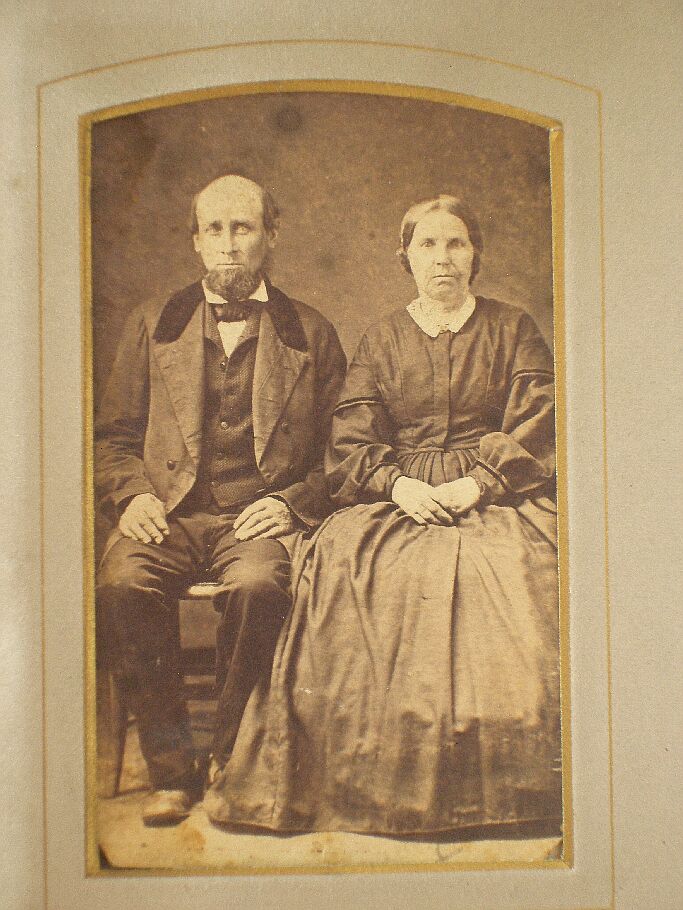
We’re pondering these good folks at the moment, my greatgreatgreat grandparents, Mr. and Mrs. Adam Crolly. Don’t they look lost in the photo annals of time? They had two daughters, Mary and Elisabeth.

Elisabeth is my greatgreatgrandmother.

Volksschule

I’ve spent the better part of this week trying to wrap my mind around the German Volksschule. What was school like in 1850’s Germany?

Fun facts to know and tell:

According to Thom Hartmann, of Mythical Research, Inc., at this article on Good German Schools, state-run schools were established in Prussia in 1756. They were not born of a desire to bestow culture on the masses, but to keep child labor from competing with adult labor, and to indoctrinate kids at a young age to learn duty and loyalty to the king and/or fatherland.

Prussian state-run schools taught the 3R’s, plus a 4th: Religion. Schoolwas compulsory for children ages 7-15, and was held 5-6 days / week until noon (a practice still continued to this day in Germany (see NY Times article by Katrin Bennhold).

German schools were generally considered far superior to American ones (although Goethe is known for stating: “America, you have it better than our continent, the old thing”). America’s public education system began in 1852 in Massachusetts, where it was modeled after the Prussian state-run schools.

Such an inauspicious beginning to our public education system (where children were forced into school as a means of controlling the unruly populace, and parents thrown in jail if they didn’t cooperate — see Hartmann link above), makes me all the more glad scholars like Rudolf Steiner came along.

Goethe

I found the Oxford Companion to German Literature at UW Bookstore for $4.99. It’s like discovering buried treasure. The information in it is assisting my knowledge of so many German greats — I am currently smitten by Goethe. (I know what you’re thinking: what took you so long.) Here is an early poem I especially like:

SONG OF THE SPIRITS
OVER THE WATERS
by Johann Wolfgang von Goethe

Man’s soul
Equals the water:
From Heaven it comes,
To Heaven it rises,
And downward again
It must descend to the earth,
Forever changing.

When there streams from the high,
Steep wall of the rock
The pure jet of water,
Then it foams in lovely sprays
In waves of clouds
To the smooth rock,
And gracefully received,
It floats, enveiling,
Murmuring softly
Down to the deep.

Where cliffs arise
In the face of the downpour,
It foams, out of temper,
Step upon step,
Down to the abyss.

In the shallow bed
It creeps down the meadowy valley
And in the smooth lake
Their countenance feast
All heavenly bodies.

The wind is the wave’s
Beautiful wooer;
The wind stirs up from the bottom
Foaming waves.

Soul of Man,
How you resemble the water!
Fate of Man
how you resemble the wind!

[translation from Introduction to Germany Poetry ed. by Gustave Mathieu & Guy Stern, New York: Dover Publications, Inc. 1987]

Not quite lost in translation

As I searched the passenger lists of ships arriving in New York’s harbor in 1857, here’s what I knew:
– that my great-great grandfather was “scarcely sixteen” (from his obituary), and that he was born in 1841.
– that he traveled on his own, without other family members
– that he was from the Rheinpfalz, then a part of Bavaria, based on how the letters were addressed:

H Johann Philipp Harm
Freinsheim
bei / close to Dürkheim
an dem Hartgebirg / at the Hart mountainchain
Königreich Bayern / Kingdom Bavaria
Rheinkreis / Rhine province
Europa

– that he probably left from Havre, France and arrived in New York, because his Uncle John Rapparlie recommended this route, in a letter dated September 8, 1850:

And if you should come so don’t take anything along except for what you have and don’t buy new pieces. Don’t take more than you need on the journey as you can buy everything here to a low price and then everything here is after a different fashion because the luggage fee costs more than it is worth. Don’t take more shoes and boots with you than you need for approximately 3 months the sea water spoils them here they are better, too. Don’t take more along than 1 to 2 boxes and turn everything into money and take checks /bills of exchange to Neujork. From there to Kleveland then none will be stolen from you and won’t get lost. And when you come so come only for yourself and don’t say my brother-in-law has lured me in. You have to come on your own risk and not accuse anybody and think I will now go to Amerika.
Another thing if you come don’t take a ship in any case from England, but from Havre, it is much more secure.

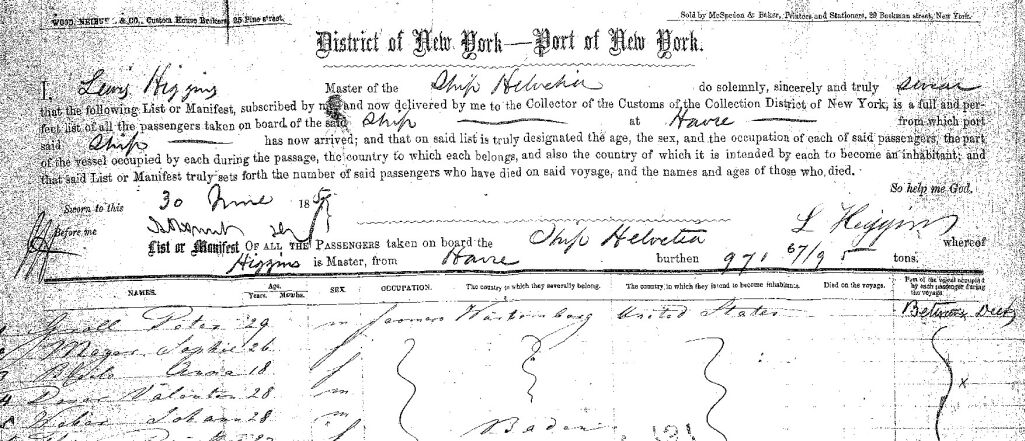
I’ve made a copy of the passenger list. The list begins with ship information:

June 30, 1857, the good Ship Helvetia

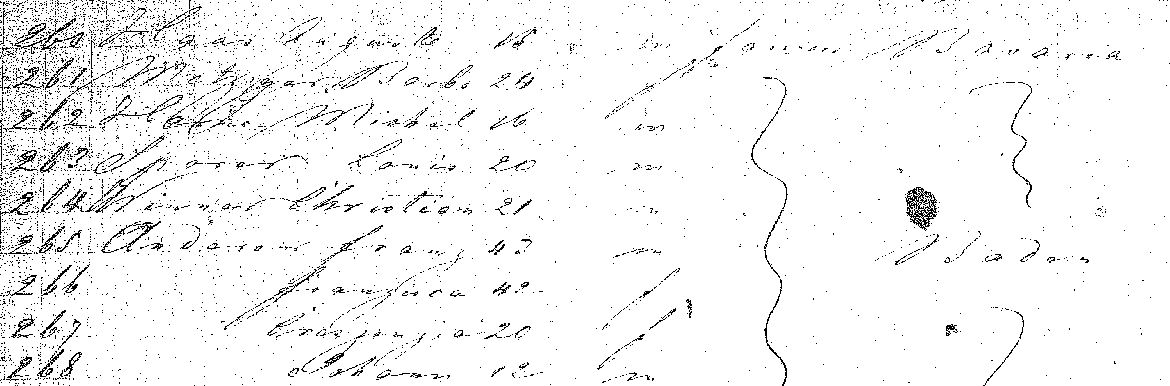
Michael’s name appears as number 262. At least I think it does. His name is spelled Michel Harm. Or maybe Michel Harne. He arrived in New York June 30, 34 days after his sixteenth birthday, May 26.

A page from the Ship Helvetia's passenger list, 6/30/1857