Author Archives: Claire Gebben

Wrought iron curiosity

When I signed up for a four-day, beginning blacksmithing class at Old West Forge, I called first with some questions.

“I need to learn about 19th century blacksmithing methods–I understand blacksmiths back then used to work with iron, and use a coal-burning forge?”

“We don’t use a power hammer here or anything like that,” Tim Middaugh said. “You’ll learn to forge by hand. But if you’re looking for iron, you’re not gonna find it here. We use steel stock, and propane forges.”

I went ahead and took the class, and got a lot out of it. And later I was able to see a coal forge in action when I visited Freidelsheim, Germany, so I didn’t feel as if I had lost out.

Still, I’ve always been a bit confused by the idea that wrought iron is no longer available. I ran across the same situation when I talked to Roger Shell at the Camlann Medieval Village about the “living history” blacksmith shop there.

“We’re thinking about forging an anvil,” Roger told me, “the way they were once made in medieval times. Trouble is, we have to wait until we collect enough iron. It’s not available anymore, so we have to get it off old junk, farm tools, that kind of thing.”

When my great-great-grandfather began his apprenticeship in 1857, I’m sure they were working with iron. Up until the end of the 19th century, it was the lifeblood of the blacksmith. Recently, I came across a terrific book called The Blacksmith: Ironworker and Farrier (Aldren A. Watson), about 19th century blacksmithing methods. The first chapter is about wrought iron, with simple and helpful definitions of various types of metal.

“Pure iron as such does not exist in a natural state. Rather, the constituents of iron are trapped in [iron] ore; in order to combine and release them, a smelting process is required. The smelting of iron ore yields a metal which always contains some carbon, the exact amount of which variously influences the characteristics of the finished iron. The more carbon it contains, the harder, more brittle, and more easily fractured it will be. Thus, cast iron is a variant of the metal which has a fairly high carbon content; iron with a moderate amount of carbon is a steel; and an iron with very little carbon in its final composition is wrought iron. … The smelting process used by New England ironmakers was an ancient one. Their wrought iron was still being made in individual, small batches by the direct process–a one-run-at-a-time method that produced blacksmith iron that could not be matched for forging qualities by any other method. This smelting process did not undergo any real change until nearly the end of the nineteenth century.”

A footnote is added, stating that the manufacturing of steel alloys has made wrought iron obsolete ” almost to the point of being a curiosity.”

Palatines to America: Ohio Chapter

In my first couple of years as a member of the Ohio Chapter of Palatines to America (Pal Am), I have become a fan (and Facebook friend). I happen to be descended from people of the Palatine region, as were the founders (in 1975) of Palatines to America, but the mission of Pal Am has broadened so much, the society might better be named “Germans to America.”

PALATINES TO AMERICA (Pal Am) is a national genealogical society of persons researching German-speaking ancestry, with emphasis on migration from the Germanic regions of Europe to North America (primarily the United States and Canada). Most of these immigrants were from Germany, but there was also a significant number from other areas of Europe including Switzerland, Austria, France, Poland, and other countries. … Now our membership includes people who have ancestors from all German-speaking areas. (from “About Us” at palam.org)

The organization, with over 2,000 members and chapters in Colorado, Illinois, Indiana, North Carolina, New York, Ohio, Pennsylvania (anyone with an interest in German-speaking immigrants can join, whether from North America or abroad), offers a wealth of German genealogy resources, newsletters, a bookstore, and more.
This year’s annual conference is coming soon:
June 14-16, 2012
“German Research: Methodology & Technology”
Indianapolis, IN

With seminars on researching, surfing the Internet, and more.

Pal Am is also offering a 74-hour search-till-you-drop genealogy research excursion to Salt Lake City September 23-30, 2012. Visit Pal Am’s web page, under Events, for details.

Pal Am also offers research and translation services.

Early, surprising uses of oil

In The Titans by Ron Chernow, I came across the following:

Oil was put to myriad uses during the Civil War, treating the wounds of Union soldiers and serving as a substitute for turpentine formerly supplied by the South. Even on the battlefield, the use of kerosene refined from crude oil spread, and Ulysses S. Grant often sat in his tent, drafting dispatches by the flicker of a kerosene lamp.

Wait, wait, back up. Did it really say “treating the wounds of Union soldiers”?! I assumed it must have been so, but had no proof until I stumbled across The Foxfire Book, the first volume in a series containing “a wealth of the kind of folk wisdom and values of simple living” from times of yore. In addition to tips on hog dressing and moonshining, the book offers a chapter on “Home Remedies,” where I found the following:

BLEEDING
-Place a spider web across the wound.
-Apply a poultice of spirit turpentine and brown sugar to the wound.
-Apply lamp black directly to the wound.
-Use a mixture of soot from the chimney and lard.
-If the cut is small, wet a cigarette paper and place this over it.
-Use kerosene oil, but be careful not to add too much or it will blister the skin.
-Use pine resin.

There are a variety of such “recipes” under each of the subject headings below, but from here on out I will only share the oil-based recommendations.

CHEST CONGESTION
-Make a poultice of kerosene, turpentine, and pure lard (the latter prevents blistering). Use wool cloth soaked with the mixture. Place cheescloth on chest for protection, and then add the wool poultice.

IRRITATION CAUSED BY INSECTS
BEE STINGS – Place either turpentine, chewed tobacco, tobacco juice, kerosene, or a mixture of sugar and dough on the sting. Any of these will relieve the pain and draw out the poison.
BUGS–For head lice (cooties), shingle hair close and use kerosene.

INFLAMMATION
-To kill infection, pour some turpentine or kerosene mixed with sugar on the affected area.

NAIL PUNCTURE
-Put some old wool rags into an old tin can, pour kerosene over the rags and light. Then smoke the wound.
-Pour kerosene oil over the cut, or soak it in same three times a day. This will also remove the soreness.

SORE THROAT
-Make a poultice of kerosene, turpentine, and pure lard (to prevent blistering), and place this on your neck. In five minutes you will be able to taste the kerosene in your throat, and the cure will have begun. Then take two or three drops of kerosene oil in a spoon with a pinch of sugar and swallow this to complete the treatment.
-Put a drop of kerosene on a lump of sugar and eat it.

In an opening paragraph of “Home Remedies,” the authors write: “Some of the remedies undoubtedly worked; some of them probably were useless; some of them–and for this reason we advise you to experiment with extreme care–were perhaps even fatal.” With such a caveat, I include this advice on curing spider bites: “If bittem by a black widow spider, drink liquor heavily from 3 p.m. to 7 p.m. You won’t get drunk, you’ll be healed.”

Reviving what was (almost) lost

The shift from the 19th to the 20th century was dramatic for its increased reliance on machines, which rang the death knell for the ancient art of blacksmithing.

“At the beginning of the 19th century, with the industrial revolution, the blacksmith craft had passed its peak. The increasing precision in dimensions of the milled iron stock fundamentally changed the appearance of finished works. Chamfering and texturing was supposed to recreate the old familiar look.

“The development of cast iron has to be considered as an additional factor contributing to the descent of blacksmithing, and the invention of new welding techniques (gas and arc welding) was the final major step towards the decline of the art of traditional blacksmithing.” (From The ABCs of Blacksmithing by Fridolin Wolf, Blue Moon Press, 2006.)

I keep an eye out for signs of the “old methods.” Here is a photo I took during a visit to Roosevelt University’s Auditorium Theater in Chicago. The building, constructed in 1887, is replete with hand-crafted balustrades.

The art of blacksmithing might have evaporated entirely, except for a few people like Francis Whitaker. Here is a Youtube of Francis Whitaker instructing others on how to make a wrought iron gate. There are important levels of initiation into the art — apprentice, journeyman, master. The way Francis Whitaker kept the craft alive was by visiting the old masters in the U.S. and Europe, and subsequently, passing his knowledge down to those eager to learn.

In 1966, just as the popularity of TV dinners were threatening yet another corrosion of people doing for themselves, the Foxfire magazine was born, a publication that began to revive ancient knowledge via interviews with residents in the Appalachian Mountains of Northeast Georgia. Numerous books and how-to publications have sprung from this initial effort.

But it appears a revival of this ancient art is underway. My niece who is currently attending CSU in Fort Collins tells me in her backyard, her roommate has cobbled together a blacksmithing forge. I hear the membership of the Northwest Blacksmith Association continues to rise. Such reports give me hope that all is not lost.

The early days of oil

In researching about my blacksmith great-great-grandfather, I’ve often turned to a book called Titan: The Life of John D. Rockefeller, Sr. by Ron Chernow.

John D. Rockefeller (born 1839) was a contemporary of Michael Harm (born 1841), and both men migrated in the mid-19th century to Cleveland to build their fortunes (Rockefeller’s fortune was more substantial and enduring, but still).

Photo courtesy of Cleveland Public Library

Rockefeller set up his first oil refineries, the Excelsior Works, Chernow writes, “on the red-clay banks of a narrow waterway called Kingsbury Run.” In this tidbit, I find two startling coincidences. One, Michael Harm spent his three-year apprenticeship in Cleveland at a wagon shop situated quite near Kingsbury Run. And two, before the refineries cropped up in Kingsbury Run, another ancestor, my great-great-grandfather H.F. Hoppensack, operated his brickworks there. In the obituary of Henry F. Hoppensack, it states: “From 1848- 1851, Mr. Hoppensack manufactured brick on Broadway Hill where the Standard Oil Co. is now located.”

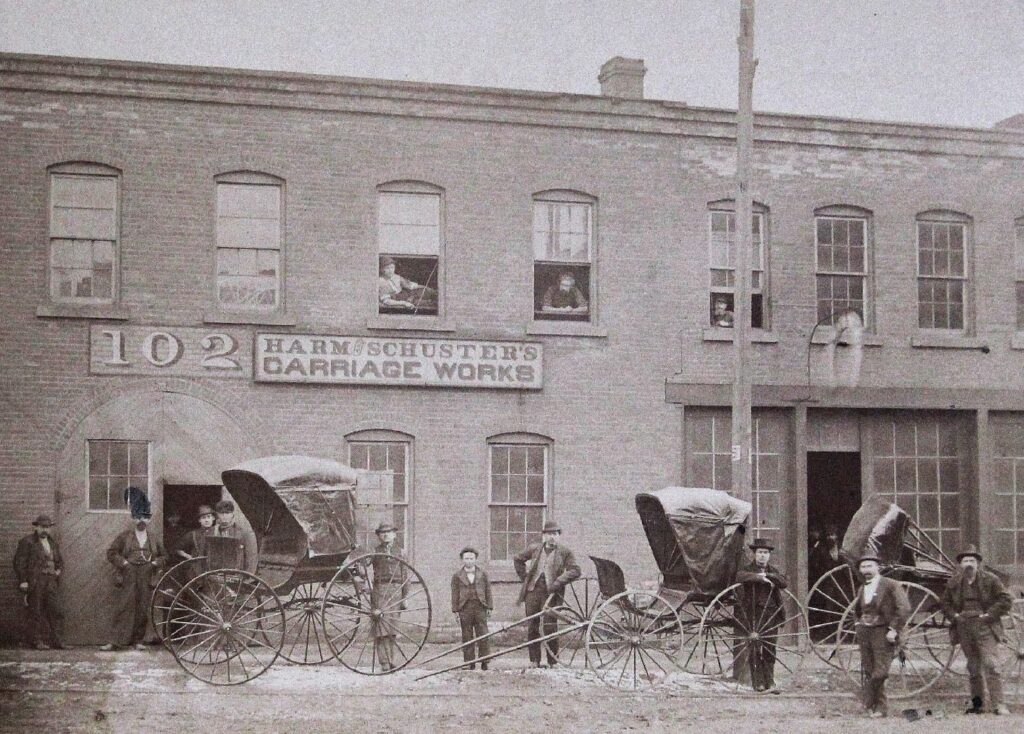
Here’s another coincidence–Harm & Schuster made business wagons for the Chandler & Rudd grocery. In Chernow’s account of Rockefeller’s life, he states: “[Rockefeller's] younger sister, Mary Ann, married a genial man named William Rudd, the president of Chandler and Rudd, a Cleveland grocery concern.”

Although John D. Rockefeller and Michael Harm were about the same age and lived and worked in Cleveland during the same era, I doubt they knew one another on a first-name basis. The English, German and Irish enclaves in Cleveland in the mid-19th century did not fraternize so often. Nonetheless, it’s a six-degrees-of-separation kind of thing. In The Titans, Chernow describes those early days of oil that I am certain had a profound impact on my great-great-grandfather, and all Clevelanders, as well.

“At the time [just following the Civil War], refiners were tormented by fears that the vapors might catch fire, sparking an uncontrollable conflagration. … Mark Hanna, who later managed President McKinley’s campaign, recalled how one morning in 1867 he woke up and discovered that his Cleveland refinery had burned to the ground, wiping out his investment …’I was always ready, night and day, for a fire alarm from the direction of our works,’ said Rockefeller. ‘Then proceeded a dark cloud of smoke from the area, and then we dashed madly to the scene of the action. So we kept ourselves like the firemen, with their horses and hose carts always ready for immediate action.’

“… In those years, oil tanks weren’t hemmed in earthen banks as they later were, so if a fire started it quickly engulfed all neighboring tanks in a flaming inferno. Before the automobile, nobody knew what to do with the light fraction of crude oil known as gasoline, and many refiners, under cover of dark, let this waste product run into the river. ‘We used to burn it for fuel in distilling the oil,’ said Rockefeller, ‘and thousands and hundreds of thousands of barrels of it floated down the creeks and rivers, and the ground was saturated with it, in the constant effort to get rid of it.’ The noxious runoff made the Cuyahoga River so flammable that if steamboat captains shoveled glowing coals overboard, the water erupted in flames.”

Randy Newman’s “Burn On” may have been about the Cuyahoga River fire in 1969, but apparently, that river had already burned one hundred years ago.

Games making history

Yesterday, Phil Humber of the Chicago White Sox pitched the 21st perfect game in baseball history. Yes, it was here in Seattle against the Mariners, and no, I wasn’t at the game to see it happen.

In a weird synchronicity, though, this week I happened to be editing a scene in Harm’s Way where the characters are enjoying some outdoor recreation. The year is 1862. What sort of game would they have been playing? Baseball?

Often, I’ve looked for answers about the past by logging into the King County Library web site to visit their 19th Century U.S. Newspapers database. First, I searched “baseball” in 19th century Ohio newspapers between 1857 and 1865. Guess what happened? “Your search found no results. Try again.” But I knew it had to be there. I have visited the Baseball Hall of Fame in Cooperstown, NY, so I knew the pastime, if not the official game, extended back to the 18th century. What did they call it back then? In a moment of inspiration, I tried separating it into two words: “base ball.” That did the trick.

From The Daily Cleveland Leader, May 4, 1858
Base Ball.
        Never within the memory of that venerable old fogy, “the oldest inhabitant,” has the “base ball” epidemic raged so fircely [sic] as at present. Fields, open lots, streets, alleys, and yards, everywhere can be found a troop of boys and men with a ball and a couple of bats, working at play as earnestly as if it were the greatest business of the day. All ages and all classes have caught the infection. The toddling, unbreeched youngster crows as he hits the tiny ball with the little wand; the school boys make the streets echo with their uproar as they dispute about a “tip” or a “first bound;” out in the fields the portly men grunt as they run past the bound, and grey-bearded Nestors plant themselves firmly to await the swift coming ball. The ragged and shoeless urchin enters with heart and soul into the game he is playing on the street; the staid merchant, the cautious banker, and the millionaire are just as excited and eager over the same game a little out of town.
        Hurrah for base ball! There is no game superior to it in strengthening the muscles, expanding the chest, invigorating the frame, and enlivening the spirits. It is a thoroughly republican game. The possession of wealth or social station does not make a man hit the ball better nor run his rounds faster, nor will the mechanic who bowls shrink from hurling a swift shot after the running millionaire. Cricket is a very good game, but there is too much looking on in it. The good “bat” has all the time to himself, and the green hand loses his first chance, and has to sit on the grass for the remainder of the day. “Keep the pot boiling” is the only way for health and fun, and this “base ball” does.

From The Daily Cleveland Herald, September 20, 1865
Base Ball.–The Forest City Base Ball Club, recently organized in this city, meet twice a week on its grounds on Kinsman street for practice, and the general develpment of muscle in its members. An exciting game was played yesterday afternoon. It is rumored that match will be arranged before many days between this club and another located in a neighboring town.

In the above articles, I notice a few variances in terminology — click here for a chronology of 19th century rules of the game. But what grabs me too is a sense of nostalgia. As a child, I remember faculty picnics and family gatherings where an impromptu baseball game was the centerpiece.

Times change. The closest “all ages” romp I can think of in recent years was in 2008, the year my son graduated from high school. That spring, the high school teachers teamed up against the seniors in a pot-boiling match of Ultimate Frisbee. History in the making.

Tom Thumb

On my recent visit to the (now-closed) Rosalie Whyel Museum of Doll Art, a doll replica of Tom Thumb was on display.

Oh right, you’re thinking, Tom Thumb, of the English fairy tale. The little guy who, among other mishaps, gets cooked in pudding and swallowed by a giant, right? Wrong.

While fairy tales endure, living breathing persons often pass out of the public awareness. One legendary personage of the mid-19th century was General Tom Thumb. Born in 1838, Charles Sherwood Stratton’s growth slowed considerably after the first six months of his life. P.T. Barnum, Stratton’s distant relative, took him under his wing and made a sensation of him in Europe. Stratton adopted the stage name of General Tom Thumb, and became a very wealthy young man. He first appears in the Cleveland newspapers in 1857.

“The Lord Mayor of London has prohibited Tom Thumb’s carriage from parading the city.” –2/25/1857, The Cleveland Daily Herald

“We understand that Gen. Tom Thumb is dangerously ill, and not expected to recover. He is, we believe, in France.” — 12/11/1857

“General Tom Thumb held a levee [reception] at the Museum, in New York, on Friday last. … He is now but little larger than a three years old child. He wears a cap surmounted by a crown not unlike those worn by the officers of the British steamers. He is quite communicative–is twenty-one years old–lives in fine style in Bridgeport, and keeps his fast team like any gentleman of the town or ton, though he seldom drives out without company.” — The Scioto Gazette, Chillicothe, OH, 3/20/1860

“Gen. Tom Thumb INJURED. –This notable personage met with a severe accident in St. Catharines, Canada, last Monday. A letter published in the Toronto Leader says:
An accident, which might have been attended with very serious, if not fatal effects, occurred this morning to no less a personage than Gen. Tom Thumb. He and his suite left the Welland House in high spirits, in a conveyance drawn by two spirited horses; they had just turned into the principal street, when the axle broke, which started the horses. The near fore wheel came off, precipitating the whole of the party into the mud, which, in consequence of the late heavy rains, was very deep. The General alighted on his back, striking his head and taking the hair clean off his crown; he was bruised also severely on his thigh. The little General, however, bore the mishap like a true hero, his favorite pipe remained in his mouth, and he continued to smoke while lying on his back in the mud.–11/14/1861 – The Daily Cleveland Herald

An article in the end of 1861 reports that while Tom Thumb toured Chicago, robbers attempted to steal his jewels, but were thwarted. Then, in May of 1862, General Tom Thumb arrives in Cleveland at 24 years of age, reportedly 32 inches high and weighing 38 pounds.

“Gen. Tom Thumb. The levees of the above ‘beau ideal’ of man continue to be well attended by delighted audiences. His impersonation of the ‘Grecian Statues’ is decidedly artistic, and call forth repeated plaudits from his audience. Mr. DaVere’s popular and pleasing ballads, and Mr. Tomlin in ‘Simon the Cellarer’ and the ‘Little Fat Man,’ tend to keep the audience highly pleased during the intervals occasioned by change of dress. To-morrow he takes his final farewell of our citizens, for he intends visiting very shortly the golden shores of California and Australia.”

In 1863, Gen. Tom Thumb married Lavinia Warren. (Notice that, in the picture above, the doll is holding a photograph of Tom Thumb and his wife.) The following article appeared shortly after their wedding:

An Intrusion upon Tom Thumb and Wife.–Mr. and Mrs. Stratton, who are now traveling through this country to let people see how small they are, stopped at the Jones House, in Harrisburgh, on their recent visit. Their levees were densely thronged, and hundreds failed to gain admittance. Among those who were disappointed were several staid gentlemen belonging to the hotel, who prevailed upon the agent to conduct them to Tom’s room, after the evening levee was over. Followed by a crowd of spectacled and reputable gentlemen, the agent proceeded to the chamber, knocked at the door, and was summoned to ‘come in.’ But when the door opened, there stood Tom in his unmentionables, while Mrs. Thumb was invisible. She had just retired, taking refuge among the cambric ruffles of a linen pillow slip, after repeating her tiny prayer, doubtless, of ‘Now I lay me down to sleep all wrapped up in a little heap.’ But the General stood defiant, with boots in hand, his brow gathered into a frown at the intrusion, which no explanation of the agent could dispel. Nothing was left but retreat.” — The Daily Cleveland Herald, 5/11/1863

The couple went on to give birth to a baby girl, and by 1864 were touring London, Paris, and Rome. Charles Sherwood Stratton lived to the age of 45.

Mosquito frets and legends

ImageSomewhere, I read (at the Cleveland Natural History Museum? the Great Lakes Science Center?) that the mouth of the Cuyahoga River was a swampy, mosquito-ridden land when Moses Cleaveland first surveyed the lots for Cleveland in 1796. When it comes to that, it still is. Enter any Cleveland woods mid-summer and the mosquito whine is sure to drive you back out.

How did 19th century denizens of Cleveland cope with mosquitoes? Window screens did not come into use until after the Civil War. Research tells me they did have mosquito nets. I also found an 1862 reference to “head-bags made of crape.” Another source mentioned a practice of wrapping one’s hands in green baize–the fabric that covered billiard tables.

A search through 19th century newspapers elicited the following:

9/8/1858 – Newark Advocate

Where Mosquitoes Come From

These pests of summer proceed from the animalculas commonly called ‘wiggle tails.’ … If a bowl of water be placed in the summer’s sun for a few days, a number of ‘wiggle tails’ will be visible, and they will increase in size till they reach three-sixteenths of an inch in length,–remaining longer at the surface as they approach maturity. … In a short time a fly will be hatched and escape leaving its tiny house upon the surface of the water. … In fact, standing by a shallow, half-stagnant pool on a midsummers day, the full development of any number of ‘wiggle tails’ to the mosquito state can be witnessed, and the origin of these disturbers of night’s slumbers thus fully ascertained. — Scientific American

8/8/1870 Daily Cleveland Herald

Sparrows and Mosquitoes

… Four years ago, 20 pairs [of English sparrows] were imported [into New York City], and provision was made for their accommodation. Now it is estimated that there are five thousand pair in the New York parks and gardens; and their active and industrious habits are believed to have materially diminished the swarms of mosquitoes which have heretofore made New York a byword and a hissing among all light sleepers who have sensitive skins. This theory is stengthened (sic) by the fact that the same experience has marked the introduction of sparrows into Jersey City–the mosquitoes having greatly diminished there even, which is mosquito land itself. If there is anything to this … then we [of Boston] go for importing one thousand, or five thousand pair at once, to be domesticated in Boston and immediate neighborhood, as a matter of more importance to the peace and comfort of our citizens than would be the addition of a hundred extra policemen. — Boston Traveler

9/3/1881 Cleveland Herald

A 15c box of ‘Rough on Rats’ will keep a house free from flies, mosquitoes, rats and mice the entire season. — Druggists

Finally, I found a reprint of this legend in the 9/7/1872 Cleveland Morning Daily Herald:

Origin of Mosquitoes

We take the following legend from the Minneapolis Tribune:

The Red River Indians have a legend respecting the origin of mosquitoes. They say that once upon a time there was a famine, and the Indians could get no game. Hundreds had died from hunger, and desolation filled their country. All kinds of offerings were made to the Great Spirit without avail, till one day two hunters came upon a white wolverine, a very rare animal. Upon shooting the white wolverine, an old woman sprang out of the skin, and saying that she was a “Manito,” promised to go and live with the Indians, promising them plenty of game as long as they treated her well and gave her the first choice of all the game that should be brought in.

The two Indians assented to this and took the old woman home with them–which event was immediately succeeded by an abundance of game. When the sharpness of the famine had passed the Indians became dainty in their appetites, and complained of the manner in which the old woman took to herself all the choice bits; and this feeling became so intense that, notwithstanding her warnings that if they violated their promises a terrible calamity would come upon the Indians, they one day killed her as she seized upon her share of a fat reindeer which the hunters had brought in.

Great consternation immediately struck the witnesses of the deed, and the Indians, to escape the predicted calamity, boldly struck their tents and moved away to a great distance.

Time passed on without any catastrophe occurring, and game becoming even more plentiful, the Indians again began to laugh at their being deceived by the old woman. Finally, a hunting party on a long chase of reindeer, which had led them back to the spot where the old woman was killed, came upon her skeleton, and one of them, in derision, kicked the skull with his foot. In an instant a small, spiral-like body arose from the eyes and ears of the skull, which proved to be insects. They attacked the hunters with great fury and drove them to the river for protection. The skull continued to pour out its little stream, and the air became full of avengers of the old woman’s death. The hunters, upon returning to camp, found all the Indians suffering terribly from the plague, and ever since that time the red men have been punished by the mosquitoes for their wickedness to their preserver, the Manito.

Blacksmith axes and the tomahawk

Because I’m researching and writing about early American blacksmithing methods, people are always telling me: “You must go to Colonial Williamsburg.” And they’re right–it is an amazing place. But not the only one.

Here’s another place I must go: Prickett’s Fort in West Virginia. Housed in a fort built in 1774, “Prickett’s Fort State Park uses a living history style of interpretation to preserve, document and exhibit the past.”

I happened upon it while searching around for more details about blacksmithing apprenticeships. Here’s a guide published by Prickett’s Fort: Blacksmithing of the 18th Century. In it, I found useful info about apprenticeships, and, as is usually the case on these research forays, something more.

The blacksmith in the 18th century could make or repair just about anything of that time, but probably his greatest accomplishment was what is known as the American Ax. Sometime around 1700, the blacksmith added a square poll on the back of the ax, which added more weight. Then by the mid-1700s, the ears were added to the eye, the square poll was elongated, and the eye was changed from round to a triangle shape. All of this added to the stability in the swing of the ax and it has seen very little change in the last 225 years.

Another important invention, that took place in the 1740s -1750s, was the pipe tomahawk. These were highly prized by the Native Americans, for they loved to smoke and make war on the settlers. The Native Americans already had the tomahawk, beginning with the first encounters with Europeans. This version added a pipe bowl and hollowed out the handle to create one of the biggest trade items used by Native Americans as well as white settlers. These were produced until well after the Civil War.

Okay, I admit the language of the guide where it says Native Americans “loved to make war” is suspect, but putting that aside, I was intrigued. On further research, the existence of the pipe tomahawk is pretty widely known; more ornate versions are still made today. May the adventures of history research never end.

Outdated? expressions

“Where do you get all these weird expressions?” my daughter once asked me.

“What do you mean?”

“Some of the stuff you say. When I say it, my friends have no idea what I’m talking about.”

“Give me a for instance?”

“Like ‘Podunk.’ Where does that word come from?”

She got me wondering. I looked it up and found its (speculative) origins fascinating. Go ahead and check it out for yourself here: Podunk

My search also turned up something more: “Slang of the American Civil War.”

In this list, I recognized a number of phrases I still say. Expressions used 150 years ago, during the Civil War. When I think about it, most of them came from my mother, whose ancestors hailed from western Pennsylvania. At moments like these, the era of Civil War feels like the not-so-distant past. Here are just a few expressions I still use.

Time to bite the bullet.
Enough of these carryings-on.
I finagled my way in.
He was fit to be tied.
We’ll get there by hook or by crook.
If I had my druthers.
What a rigamarole!

Finally, have you ever wondered about the phrase: I heard it through the grapevine? It turns out “grapevines” were telegraph wires. By Jiminy!