Politically incorrect

I’m in a class with Carmen Bernier-Grand, and as we are workshopping our novels-in-progress, she raised a valid question.

“Do you have to refer to the nineteenth-century Indians as ‘wild’ and ‘brown'”?

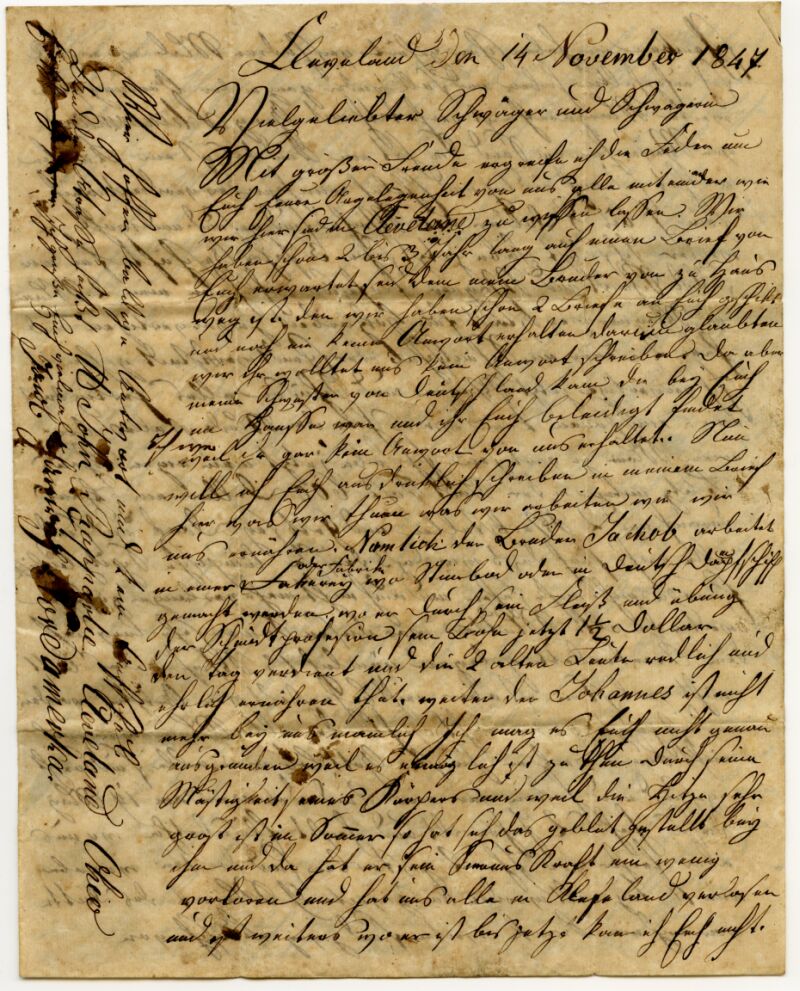
The terms bother me, too. But I’m basing my novel on real letters from the mid-nineteenth century, and this is the language Jakob Handrich used. Here is a quote from his letter, which accompanied a package that contained vests and moccasins, written in 1849:

“The shoes, that is the work which the wild people or the brown Indians make.”

It seems it was a common reference — I’ve also come across the term in the book Pfälzer in Amerika. ‘Brown’ and ‘wild people’ are politically incorrect terms, and for that matter, just plain inaccurate, yet they seem gentle when compared with language used by the Yanks. Here’s one example I found in a speech by Ohio’s Governor Arthur St. Clair to the Ohio State Legislature in 1812:

“The government of the United States has ever with an unceasing philanthropy, and great expense, labored to civilize the Savages on her borders–to diminish the ferociousness of their natures–to cultivate among them the arts of peace–to estrange them from the cruel rites of Molock–and to inspire them with a true knowledge of a beneficent Deity.”

Hmmm. He goes on to say that, thank goodness, the U.S. has passed laws to extinguish the territorial entitlements of these “heathen remnants.” Ye gads! A glimpse of the white, barbaric mindset of the nineteenth century. It’s like we Ohioans were savages or something.
Sad but true

In the book “Ohio: the History of a People” by Cayton, one paragraph sums up the decimation of the native tribes of Ohio.

“The population of Ohio exploded in the first half of the nineteenth century. From 45,365 in 1800, it rose to 230,760 in 1810, 581,434 in 1820, and 1,980,329 in 1850. Virtually barren of English-speaking residents in 1790, Ohio was the third largest state in the Union by 1850 … The U.S. had extinguished the claims of Indians through treaty cessions, most notably the Treaty of Greenville in 1795, an 1817 Treaty with the Wyandots, and St. Mary’s Treaty of 1818.”

By 1832 the Wyandots, Shawnee, and Senecas were confined to the Upper Sandusky. By 1842 they were moved west of the Mississippi.

According to Cayton, the mood of the Ohioans in the early nineteenth century was one of progress, of “the triumph of civilization over barbarism.”

In my research I’m discovering evidence that many German immigrants thought differently, their thinking influenced in part by romantic poets and ideas of the day. Key principles of the romanticism movement included a spiritualized view of nature, and the desire to lose oneself in it.

In 1849, Uncle Jakob sent two Indian vests and a pair of moccasins to his nephews and niece in Germany. I’d like to believe he saw the Indians as artisans, and as human beings.

Fiske Genealogical Library

I spent a couple of hours at the Fiske Genealogical Library today. They’ve got all kinds of great helps and classes. Gary Zimmerman was there (Fiske’s Board President); he helped me locate resources such as the book Cleveland and its Germans. Just searching the title on the internet led me to a whole wealth of other resources, too.

The Meyers Gazetteer (circa 1910) revealed the following information about Freinsheim. Population, 2,586. Home of an apothecary, mining, cement mixing, fruit orchards, and of course, a wine-making fabrik. It was also worthy of note that the town was home to a fire-fighting machine. With good reason — in 1689, the entire town was burned during the War of Succession by Louis XIV, leaving only its walls.

My research also turned up this RootsWeb’s Guide, with many links to ancestor searches.

Tintypes

I came across a box of tintypes. Apparently there is not really any tin in tintypes. It was a very early kind of photography, invented in the 1850’s, where a direct positive image is affixed on a sheet of metal by emulsion. They were the first “instamatics” — the process would only take a couple of minutes. Interestingly enough, it is possible to scan the tintypes and get a semblance of the image from the metal.

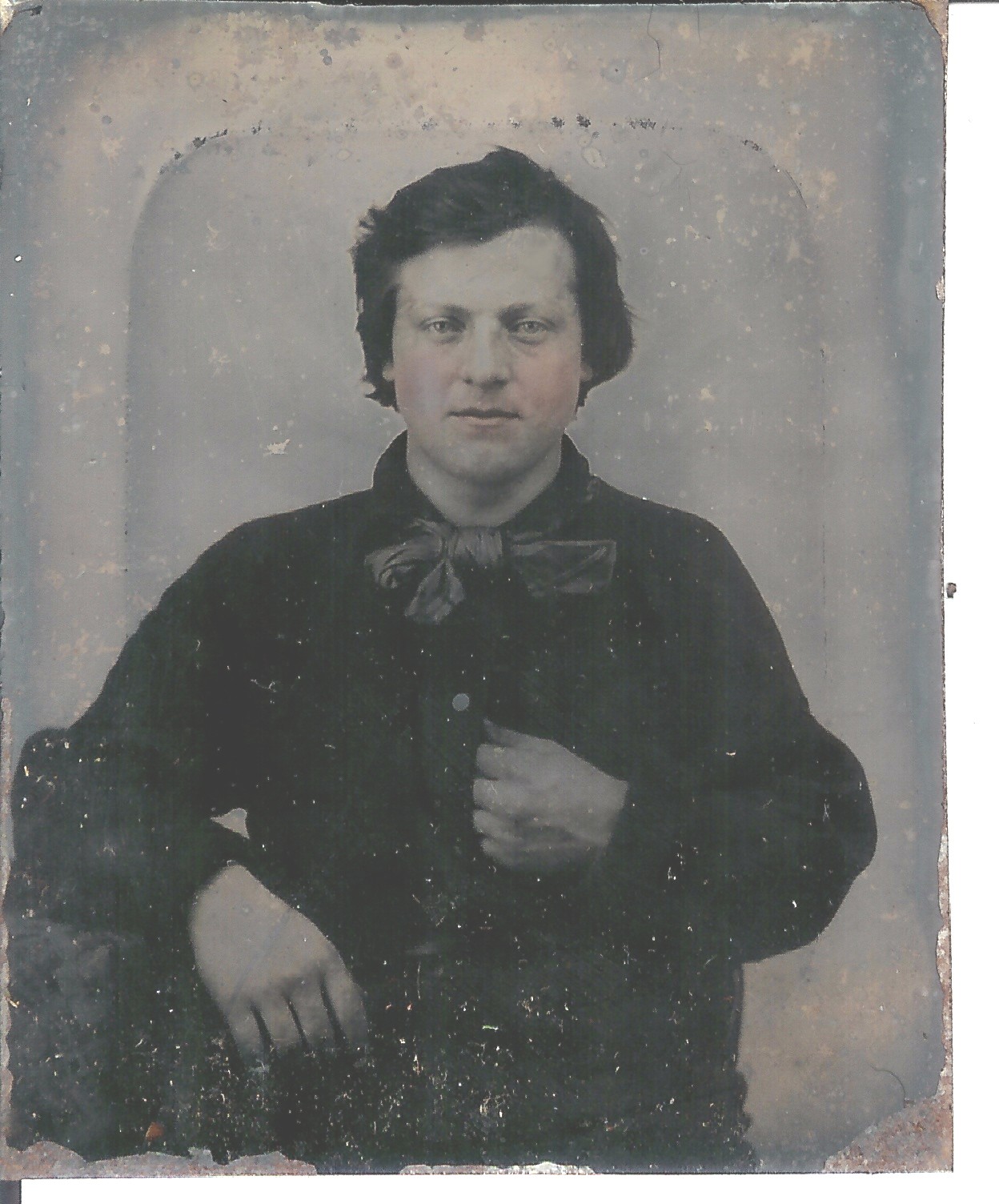
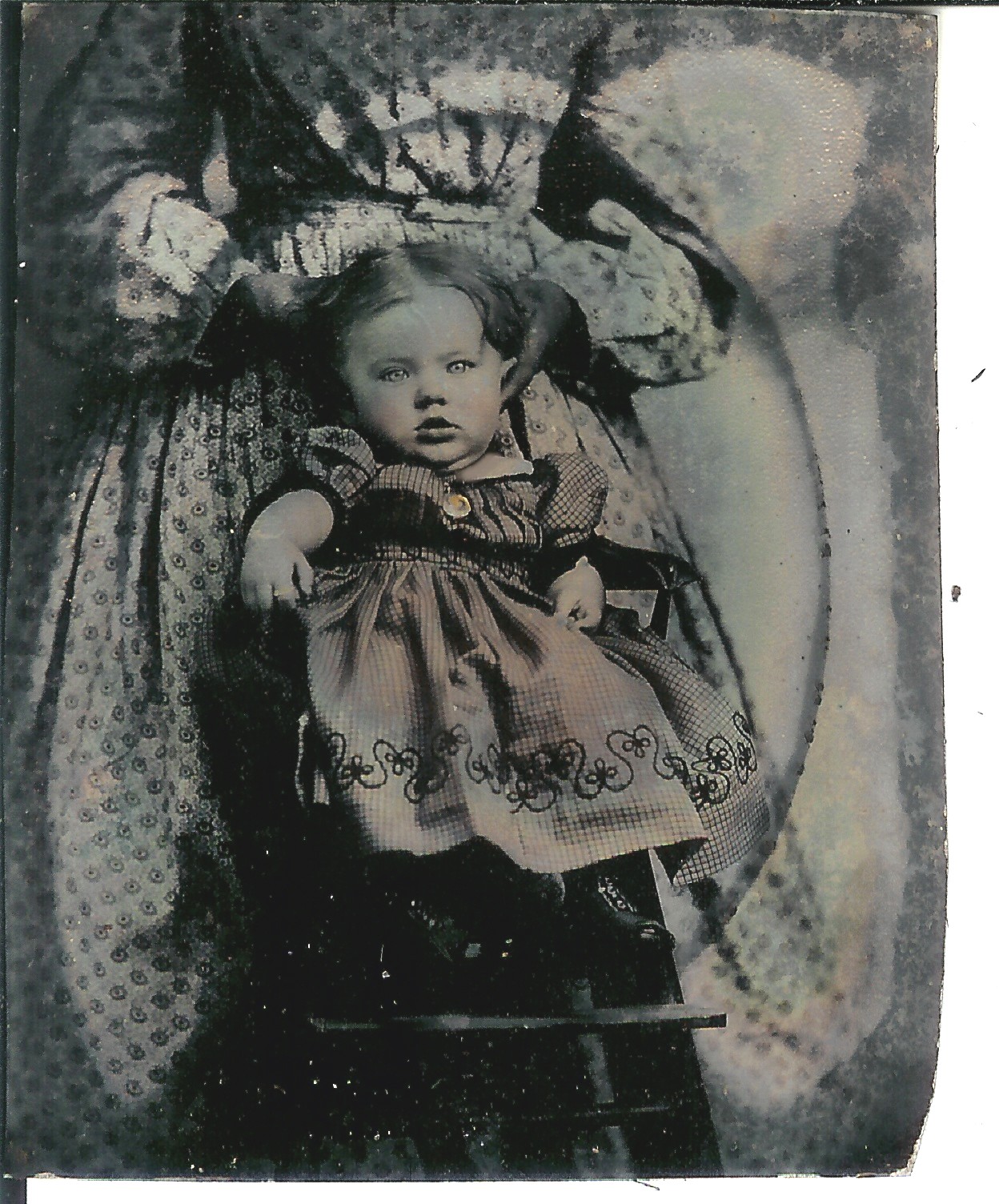
Here is a tintype of my greatgreatgrandfather and a tintype of his daughter, my greatgrandmother, Lucy.

Michael Harm, 1857

Lucy Harm


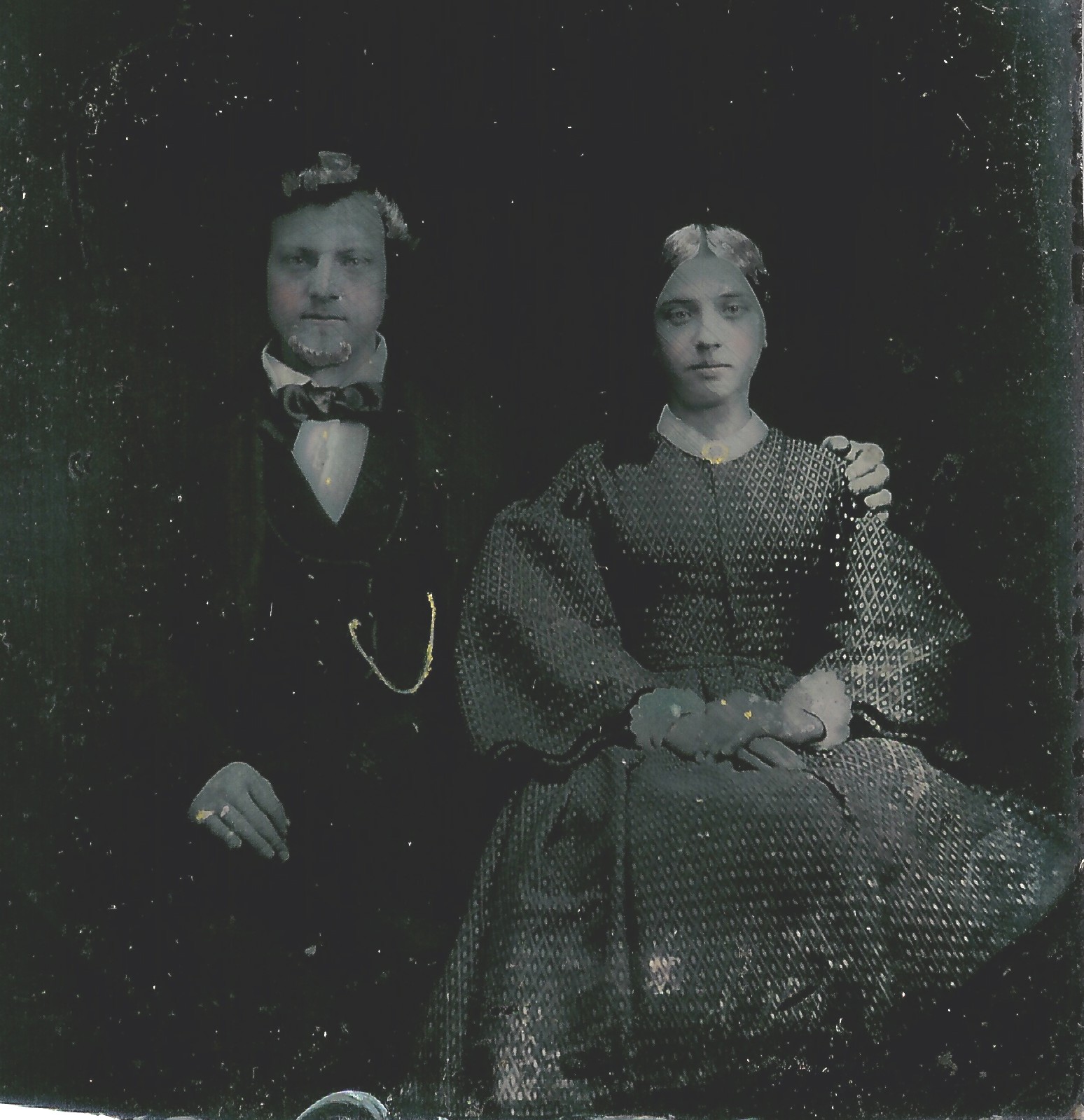
There’s also an ambrotype of Michael and his wife Elizabeth. The ambrotype was an image on glass. It didn’t stand the test of time as well as the tintypes, but here’s what’s left of the image:

Lost in the mail

Letter from Cleveland, Ohio, 1847, Johannes Rapparlie:

With great joy I pick up the pen to let you know about our matters like all of us are here amongst each other in Cleveland. We have already waited for two to three years for a letter from you since my brother has left from home as we have already written two letters to you and not yet received answer. Therefore, we thought you didn’t want to write us answer but when my sister came from Germany she was insulted because you hadn’t gotten any answer from us.

Email from Freinsheim, Germany, 2009, Angela Weber:

i asked my mother to please send me the letters from Freinsheim and the little package didn’t arrive for some days now… i will ask at the post office tomorrow, maybe because of our new address???
[then a month later] What has happened, the box with the letters had been lost in the German mail and only arrived last week after we had initiated search and everything. The outside paper was ripped off and the parcel could luckily be identified because of the contents. We waited for 4 weeks and called here and there, the mail recently has a bad reputation with reliability. I suspected they want to force people into using the more expensive services with insurance attached. I also suspected theft because of the value of the old stamps, and it was the horror, to think that way. Well, everything good now, but I am really hesitant to send the letters again.

Letters lost and found. Like history. Some say we should only look forward, but we aren’t the first, nor will we be the last …

The good ship Helvetia

Now I’m getting somewhere. Today at NARA, I found the name Michel Harm listed on a passenger list from the good ship Helvetia, captained by Lewis Higgins. The ship arrived in New York on June 30, 1857 from Havre, France. There were 327 passengers, one of whom, #262, is listed as Michel Harm, age 16, of Bavaria. The ship is described as having 971 burthen and weighing 67 / 95 tons. Michael is one of the many Germans, Swiss, Belgians, French and Sardinian emigrants residing “between decks” for the voyage. (The ship had predominantly German passengers, from Wurttemberg, Baden, Bavaria, Hessia, and Prussia.)

This information corroborates with Michael Harm’s obituary, which reads in part:

Born on May 26, 1841 in Freinsheim in the Rhine-Palatinate … Michael Harm’s maternal grandparents, the couple Philipp Heinrich Handrich, had already come to Cleveland in the year of 1840 and had settled there. … At scarcely sixteen, the boy started the journey. After a short rest in the port city [New York] Harm continued to Cleveland and started an apprenticeship with his Uncle John Rapparly who was established as a wagon building and blacksmith on the corner of Michigan and Seneca streets.

It also corroborates with my father’s account Michael’s voyage across the Atlantic took 46 days.

So now I’ve gone looking for the good ship Helvetia, and what I’ve turned up is a description of a ship built in 1864. Hmm. The date is off. I must keep digging.

Archival ponderings

I wonder why it is that I am determined to find my great-great grandfather’s name on the passenger lists from Germany. I’m glad I found NARA the National Archives and Records Administration on Sand Point Way. We are all sleuths, we visitors to these microfilm stacks, hoping to unearth ancient data of the U.S. Census, naturalization and passenger arrival records, Native American records or African American slave ship records. The volunteers are a rare breed, too–friendly, helpful, not overly interfering.

On the passenger lists I’ve been perusing, the handwriting is terrible, the ink faded. I presume they were using steel-tipped pens but dipping them in ink wells. The fountain or reservoir pen didn’t come into common use until around 1880. Check out this Early Office Museum web site where you’ll find cool facts about the history of the pen.

I’m glad I know Michael Harm was barely 16 when he traveled across the Atlantic, because I can scan the age column for the number 16 much more easily than the name column, where the handwriting is faded and barely legible. As I cruise through page after page of German names, the song: “John Jacob Jingleheimer Schmidt” plays relentlessly in my head. By the way, that particular ditty seems to have originated in vaudeville acts of the nineteenth century (Wikipedia). What a glorious distraction research can be.

Not so commonplace

When I walked into the University of Washington, a complete neophyte, to begin my thesis based on old family letters, I first sought out the reference desk. “I’m looking for books about the German immigrant community in Cleveland in the mid-1800s,” I said.
The reference librarian nodded sagely and clicked a few keys on her keyboard.
“Steamboats might be a keyword,” I suggested, “or Erie Canal.”
“There are 11 entries.” The librarian turned the screen so I could see it too. We scrolled through the list. “You know,” she added, “my family is predominantly of German ancestry. We arrived in Ohio in that same time period.”
“Really? In Cleveland?”
“No, Toledo.”
So many people I tell about my thesis have stories about their German ancestry, and often, an Ohio connection. Yet there seems to be very little written about the mid-nineteenth century wave of immigrants. UW library did have A History of Cleveland in their holdings. The book notes that by far the strongest ethnic groups to settle Cleveland were the Germans, with the Irish running a distant second. The 1910 History notes: “[Cleveland’s] principal ethnic parts were the English, the Irish and the German, the last two greatly preponderating. Unfortunately there are no reliable data of the earliest arrivals in Cleveland of these emigrants.”
When these crinkled letters, wrapped in string, written in old-fashioned German script with loopy esses, appeared among my father’s belongings, we assumed the discovery was commonplace. It turns out, it was not.

Passenger lists

I keep trying to picture the ocean crossing from Europe to the New World in the 19th century. Yesterday, I went to the National Archives and began the laborious process of scrolling through microfilm! records of passenger lists. I have not yet found my great-great grandfather’s name among them. I looked through three month’s worth, from January through March of 1857, and it took three hours. I don’t even know for sure what year my ancestor arrived — it might have been 1858 — it’s going to take several days of research.

Here’s what I discovered:
-The ships arriving in New York from Havre were mostly chock full of German immigrants. The ship called “William Nelson” arrived 1/3/1857 in New York’s harbor with 226 adults, 67 children, 7 infants, and 1 baby born on the passage. The passenger lists give names, ages, trades, and cities of origin. The top entry on the pages and pages of names often says “farmer” and then there’s a squiggly line down the column indicating every single name on the list had the same occupation.
– The passengers were predominantly from Württemberg and Baden, two separate states at the time. Other areas listed were Bavaria and Prussia.
– A steamship from Liverpool called “City of Baltimore” carried 160 passengers on 2/14/1857 — 34 U.S., 45 English, 10 Scotch, 60 Irish, and 16 Germans. (While the ships from Havre and Bremen designated the passengers by state (Baden, Württemberg, etc.), the English ships categorized them simply as Germans.)

And those are just two of at least two dozen ships coming into port from Europe. Imagine all these newcomers pouring into New York: merchants, millers, shoemakers, laborers, barbers, brewers, painters and domestics. Bakers and mechanics. Plumbers, saddlers and miners. Blacksmiths.

Title quandries

So my working title is “Wrought Iron.” I’m told it might be best if I come up with another one. Maybe so, maybe so.

I’m currently reading the book What God Hath Wrought: The Transformation of America, 1815-1848 (Oxford History of the United States) by Daniel Walker Howe. Here’s an applicable quote (p. 530):

In Europe, people had fled to the cities for generations; the German aphorism Stadtluft macht frei (“city air makes one free”) referred to more than freedom from feudal dues. Young American and their immigrant counterparts voted with their feet against staying on their fathers’ farms. … Together, urban places and the western areas opened up to markets by waterways received adventuresome souls fleeing the backbreaking toil, the patriarchal authority, and the stultifying isolation of semi-subsistence farming.

“Markets by waterways” — one such key location was Lake Erie at the mouth of the Cuyahoga River, aka Cleveland, Ohio. I’m amazed how perfectly my greatgreatgrandfather fits this description of adventuresome souls fleeing backbreaking toil. Howe’s book even has a black-and-white plate of a blacksmith of the time period wearing a rawhide apron. From farmer to blacksmith — hmm not exactly an escape from backbreaking toil — perhaps the city air didn’t quite live up to that old German aphorism?