Then and Now

When I was in Cleveland this spring, I cruised up and down Euclid and Carnegie and Prospect, existing in the “now” while in my mind’s eye trying to conjure “then.”

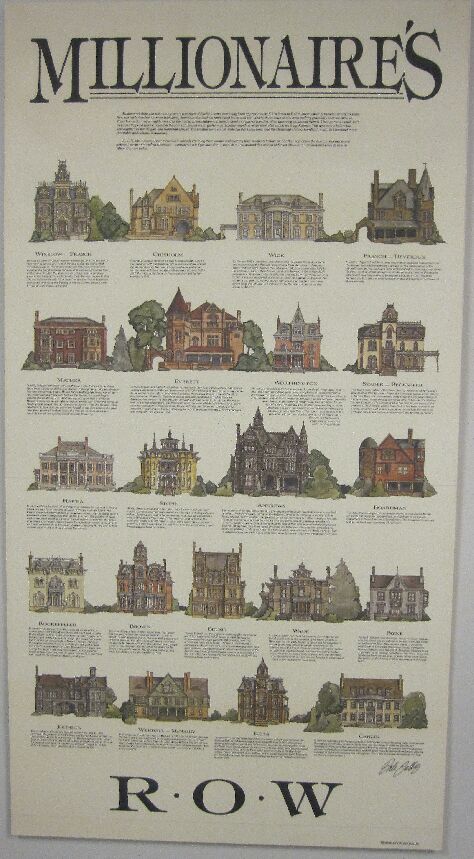
One “then” that’s gone entirely is “Millionaire’s Row,” so named for all the enormous mansions that used to line Euclid Avenue, inhabited by the likes of Rockefeller (Standard Oil), Brush (inventor of the Arc Light), Payne and Hanna (U.S. Senators), Wade (founder Western Union Telegraph) and so on. (Don’t get me wrong–greater metropolitan Cleveland still has its mansions. If you don’t believe me, take a spin down South Park.)

Cleveland grew, and by the early 1900’s the millionaires had moved on. At the Cleveland Public Library, in the maps collection, I was taking a picture of the poster of Millionaire’s Row when a fellow library visitor came over to chat. “It’s all gone now, but you can tell where it used to be on the early maps,” he told me. “The owners along Millionaire’s Row didn’t want all kinds of folks riding the street car past their houses, so when the City put in the street car, they laid the track on Euclid until right where the mansions began, took a detour over to Prospect, then back to Euclid later.”

Harlan Hatcher, in his book The Western Reserve, notes the Samuel Andrews mansion at the corner of Euclid and 30th had 33 rooms. Men servants wore eighteenth century style knee breeches, velvet jackets, and silver buckles on their shoes.

After the family abandoned the mansion, it was torn down, and people used the foundation to play miniature golf. Only one house, the Beckwith mansion, still stands, home of today’s University Club.
What a find

Big Find 1: In my search for the good ship Helvetia, I was sailing on storm-tossed seas until I encountered TheShipsList. What a bountiful resource that turned out to be.

I’ve had a deepsea plunge through what’s offered there, and best of all, in the deepest water at the bottom of Resources Links page are “Email Discussion Lists.” (Thank you, Sarah.)

I subscribed to the one that offered discussion opportunities on immigrant vessels and put out my query. Others on the listserve were quick and generous in responding with what they knew: about the metalling of hulls, about life at sea, on ports where the Helvetia was registered, on the ship’s rigging and number of masts.

Big Find 2: Heritage Quest through my on-line King County Library System. In the 1860 Census, for some strange reason I could not find Michael Harm via name search. I knew he was in Cleveland at the time, and even his address.

So I took the slowpoke, painstaking approach. I compared Michael’s address with an old map to determine which “Ward” he lived in. (The 1860 Census was broken down by Ward.) I browsed page by page through the 1st Ward Census data, and sure enough, I found him. On the 1860 Census, my greatgreatgrandfather’s name is Michael Hiram. He was living at the time with Uncle John Rapparlie, scrawled out on the census as something like Raferlu, though I have yet to find the listing via name search. But there they all are. And the tenants and workers in Uncle John’s wagon building shop, too.

So let’s see, we’ve got Michael Harm listed in various places as: Michel Harne, Harm, Hann, and Hiram. And his bride as Elizabeth Crolly, Crolley and Crowley. But it’s par for the course. Don’t even get me started on how many ways there are to spell Gebben.

Getting nowhere

I’ve made progress in genealogy, in history, in German, in blacksmithing, but when it comes to nineteenth century Atlantic crossings, I’ve hit a brick wall. Make that a sandbar.

I’m looking for information on the transatlantic crossing from Havre, France to New York harbor in the mid-nineteenth century. I have a copy of the passenger list of the ship on which my great-great grandfather sailed.

Internet searches for pictures of his 1857 ship Helvetia, captained by Lewis Higgins, have yielded nothing. What kind of ship was it? I found the Helvetia as later showing up in Victoria, B.C. in August of 1857. But such entries are thin gruel when I’m looking for fruit and nut-laced oatmeal, like diaries and personal accounts. Or a captain’s log, say. Stardate 1857.

The Smithsonian book “Ship” by Brian Lavery informs me that the “French Messageries Maritime” was a major shipping line. There was also the “Compagnie General Transatlantique” service from New York to Le Havre.

Family legend has it the crossing took 46 days. That’s a long time, even by 1850s standards. It must have felt to my great-great grandfather like he was getting nowhere.

Genealogy know-how

I started an MFA in Creative Writing to boost my novel writing skills, but as it turns out, the writing part of a novel is just one piece of the puzzle.

Since I’m writing about my greatgreatgrandfather (born in Germany and based on letters written in German), I’m trying to swallow the German language in one gulp. If only I could inherit the German language the way I inherited my fondness for sauerkraut. But alas, I’m stuck doing it the hard way, studying German on-line and in a local class. And during the Seattle Film Festival, I’m taking advantage of some movies in German. (I gave the movie Soul Kitchen, the highest rating, a 5.)

With historical fiction, there’s also the research steam train, with all of its tunnels through archival libraries and hairpin curves around landslides of historical data not relevant to my specific project.

But perhaps the most daunting has been the genealogy research. It’s like the corner background of the puzzle, a forest at twilight, say, all light and shadows melted together. It’s taken persistence and lots of sleuthing.

But thanks to my friend David Williams, I feel like I’m at the a firmer outline, along the edge of the trees and moving into blue sky. Dave has some experience with researching his own family history, with inspiring results. What’s more, he’s introduced me to Sarah Thorson Little, who teaches genealogy and family history. Here’s my hot tip of the day, about organizing my research, thanks to Sarah: Organizing Computer Genealogy Files.

Puritanical snubbery

I’ve been reading Goethe — most recently his novella Elective Affinities.

Never heard of it? No surprise there. The introduction to the translation I’m reading (Goethe: Collected Works, Volume 11, ed. by David Wellbery, transl. by Victor Lange and Judith Ryan, New Jersey: Princeton University Press, 1988) says: “Elective Affinities never really gained entry into the American reader’s canon of favorite literary masterpieces.”

What’s up with that, I’m wondering as I begin the story. I’ve already read The Sorrows of Young Werther, the first of the two collected works in this volume, which reads like a 19th century novel. (If you ever read George Eliot’s The Mill on the Floss, which ends with a brother and sister floating down a river in each other’s arms and drowning, you’ll see what I mean. That book ends badly, as does Moby-Dick.) Writers of this era were not at all shy of tragedies, and Sorrows, naturally enough, ends with poor young Werther dying of a broken heart.

Elective Affinities begins with the upper class, not unlike a Jane Austen novel. But in sketching the social manners of the day, Goethe is not nearly so prim and proper. No sirree. Already by Chapter 13, a Count and a baroness, each currently wed to others, meet at the good Edward and Charlotte’s estate for a tryst. Edward and Charlotte, bless them, are married to each other, but they are seriously pursuing inappropriate sexual affairs with other houseguests.

The United States might have been the land of the free, but they were devout, temperance-loving puritanical prigs as well, certainly not of a mind to condone some German tale of rampant promiscuity. That’s my theory about why it never “gained entry”. Puritanical snubbery.

The art of blacksmithing

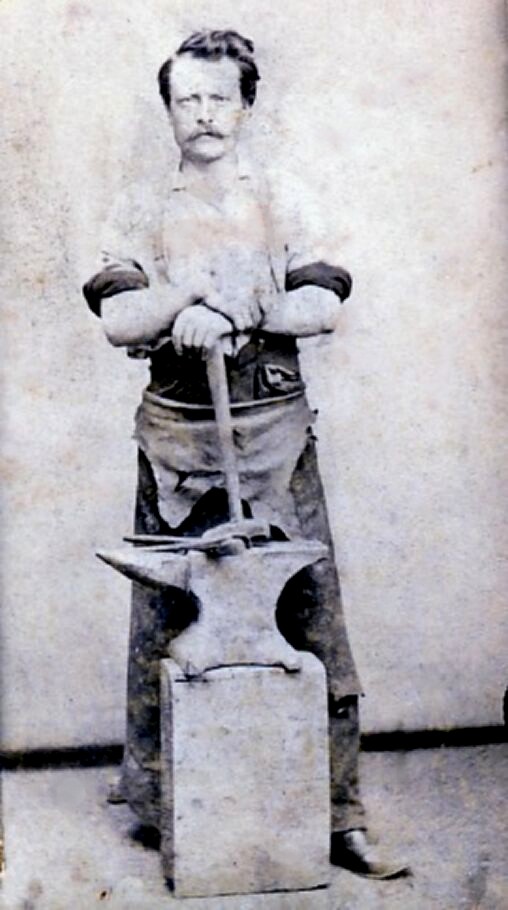
For my MFA thesis, I’m writing about my great-great grandfather, who apprenticed as a blacksmith in Cleveland, Ohio in the mid-nineteenth century. Here’s a picture of him.

Unfortunately, as a 20th/21st century woman, I don’t come across the blacksmith craft very often. So, my plan is to take a class this June at Old West Forge.

I know a metalworker named Pia, of B32 Metal Fabrications and the other day I was talking with her, nervously, about my upcoming class at Old West Forge.

“How should I prepare?” I asked her. “Lift weights? Walk on my hands?”

“I’d practice my aim,” Pia told me. “If you can hit the mark with your sledgehammer, it will be a lot less frustrating.”

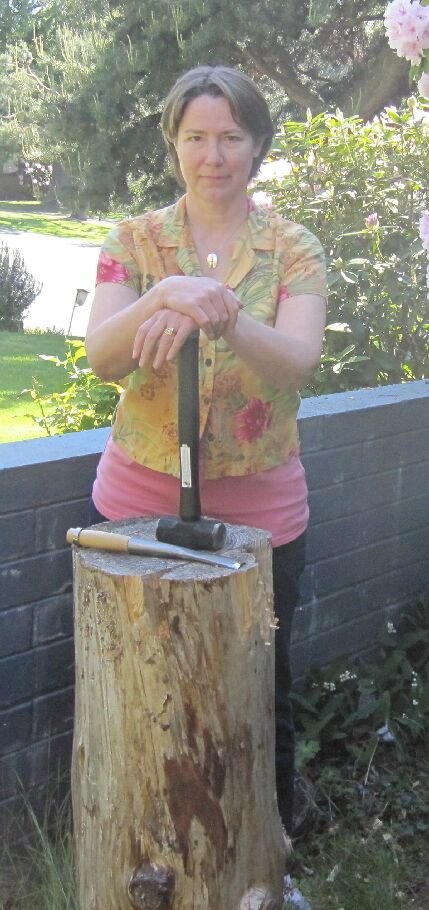
I don’t have an anvil at home, but I do have a large cedar log. Hence, for Mother’s Day I asked my husband and kids for a set of large wood-carving tools, specifically a straight chisel, a gouge, and a small sledgehammer to pound with … and got them! I couldn’t be more delighted.

Already, I’ve been practicing my aim, and so far, haven’t done injury to myself. Somehow, though, I think it’s going to take more than this to measure up come June.

What’s in a word?

What’s in a word? Always more than I expect. Today as I was writing I got hung up on the word “wanderer.”

Should I use the German version? I wondered. When I looked into it, I realized the German word and the English words are exactly the same.

So I initiated a search for alternate German words for wanderer: roamer, vagabond, which elicited Wandervogel.

Okay, Wandervogel. Promising. Via my studies of the German language, I’m pretty sure the literal translation would be “wandering bird.” Simple enough. But the next place I look, at the on-line translation.babylon.com/german, it gets more involved: Wandervogel: “n. bird of passage, wandering bird, rolling stone, vagabond, one who does not settle in one place, temporary tenant, temporary resident.”

Cool word, I’m thinking. Lots of subtleties here–maybe a good word to use for an immigrant who keeps returning to his homeland, migrating back and forth, driven by a natural urge.

Just as I’m about to topple off the fence on the side of a hearty “Yes!” Wandervogel is just the word I’m looking for!”, I make a last Google search, which pulls up, naturally enough, Wikipedia, an entry about German nationalist youth groups. A heap of twentieth century baggage I’m not willing to unload off the truck.

Thirty minutes later, I’m back where I started. For now, I’ll stick with wanderer.

Lost and found

In the letters my cousin and I translated, mention is often made of Jakob Handrich. He was the uncle of Michael Harm, the one who sent the Indian vests and moccasins to Freinsheim. My great-great-great-uncle.

Jakob was just 18 years old when he arrived in Cleveland. He started out as a cooper making barrels, then went on to building steamships in a plant on Lake Erie.

One letter mentions he traveled to the south, to New Orleans. Another says he went to California for the Gold Rush. Another that he bought land and built a house for himself and his parents in Cleveland. Then that he went to Columbus to work, while his wife and child remained in Cleveland. Then, that’s it.

“It’s really strange,” my cousin said, “that we don’t hear any more about Jakob Handrich in the letters.”

The comment sparked my curiosity, so I searched death certificates on-line, and found a Jacob Handrich in Buffalo. But the dates were off. Then I thought to search other spellings of the name.

And that’s how I think I found him, under the spelling Jacob Handrick, through FindAGrave.com. At Green Lawn Cemetery in Columbus, Ohio. The grave lists him as born 2/22/1822, died 1/25/1896. How he ended up there is still a mystery, but I’m pretty sure the lost has been found.

Art

My historical fiction novel writing friend advised me to look into art. “It’s a great resource for costumes and scenes and hints about the way people used to live.”

Yesterday afternoon, I stopped by the Cleveland Art Museum, and I now get what my writer friend means. Before the Impressionists, art functioned as photos do today — portraits, but also scenes of people living their lives. The Cleveland collection has some gems, and there’s no admission charge. Just wander in the door and view to your heart’s content. With permission, I took non-flash photos in the nineteenth century rooms.

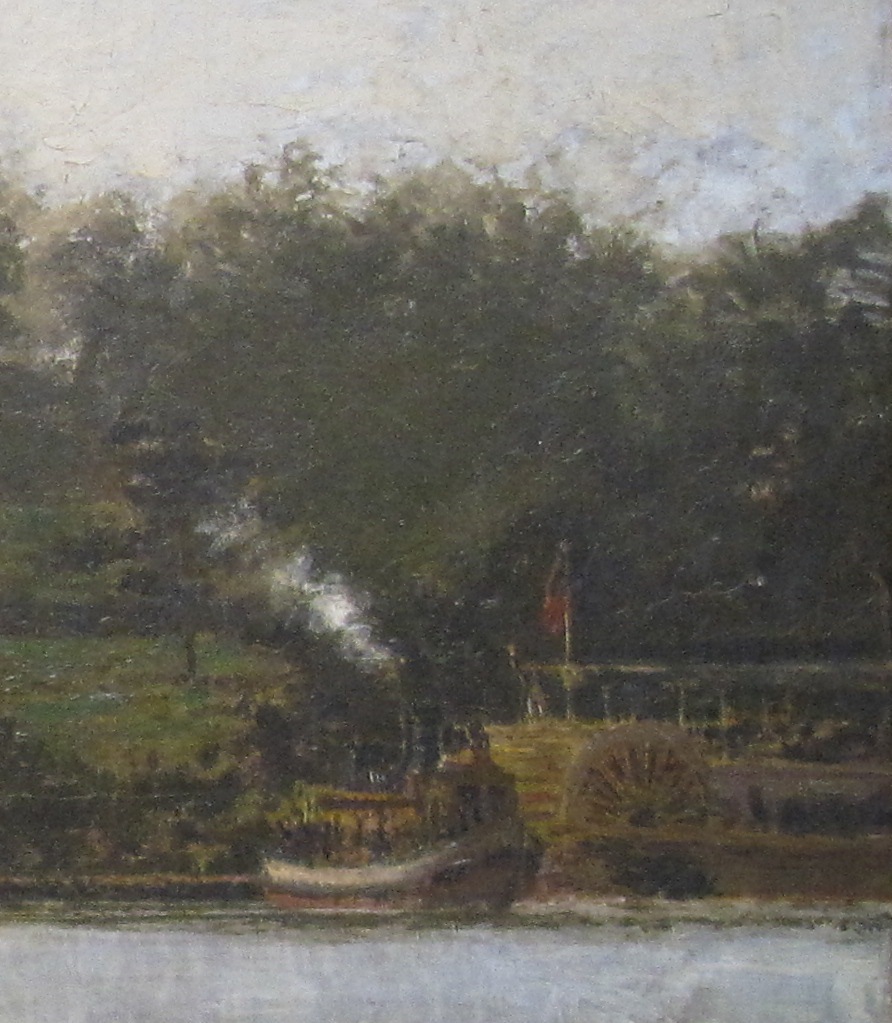
“The Boat Builder,” 1904 is by John George Brown. The painting of the steamships is a detail from a much larger painting by Thomas Eakins called “The Biglin Brothers Turning the Stake,” 1873.

Little did you know

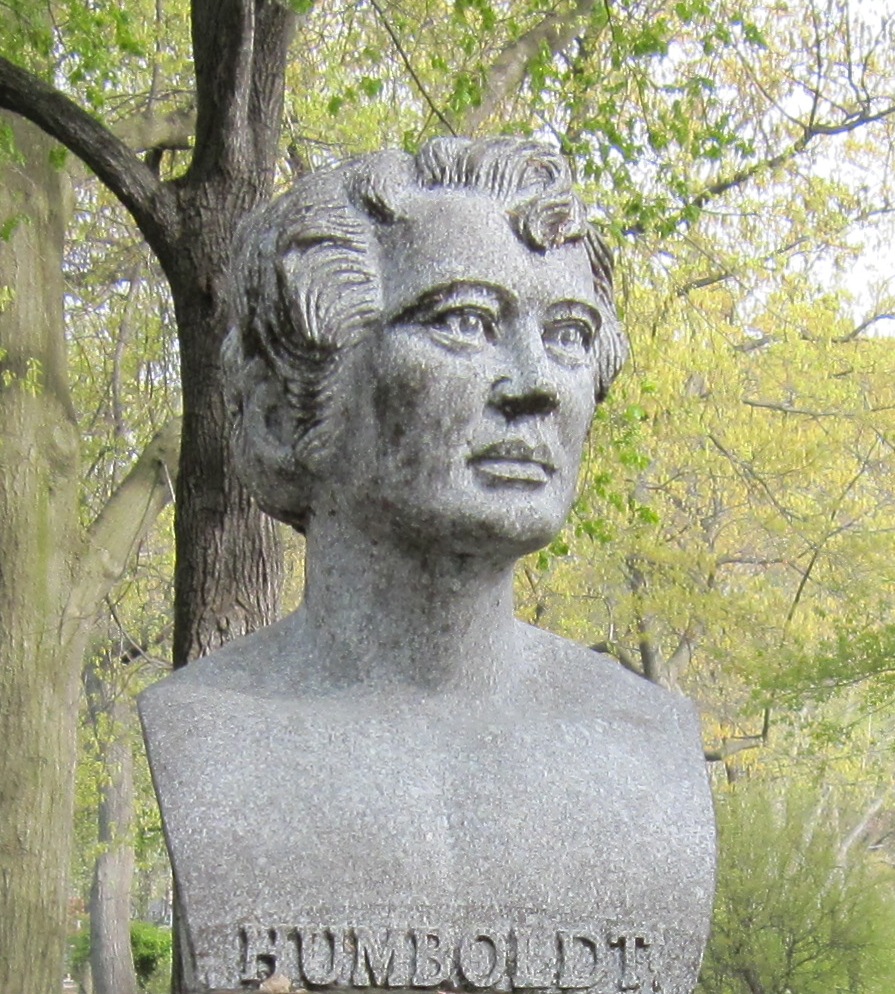
Have you ever heard of Alexander von Humboldt? He is considered “The Great Naturalist.” A statue in his honor is erected in the German Cultural Garden. According to author Aaron Sachs, the name Humboldt was on the lips of just about every citizen of the nineteenth century. The Humboldt Current, by Aaron Sachs, is a terrific read about Humboldt and the roots of American environmentalism.

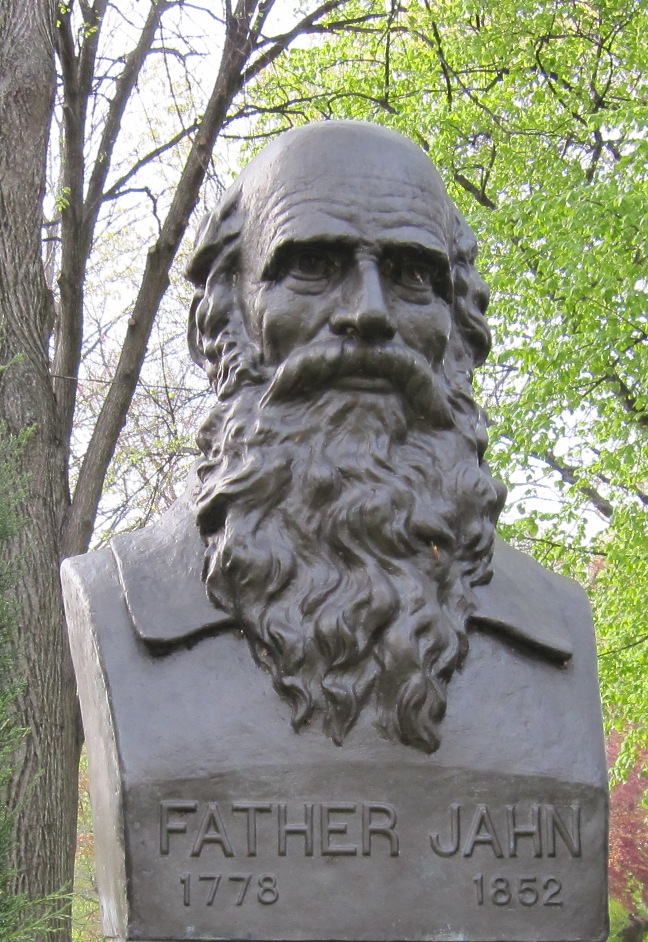
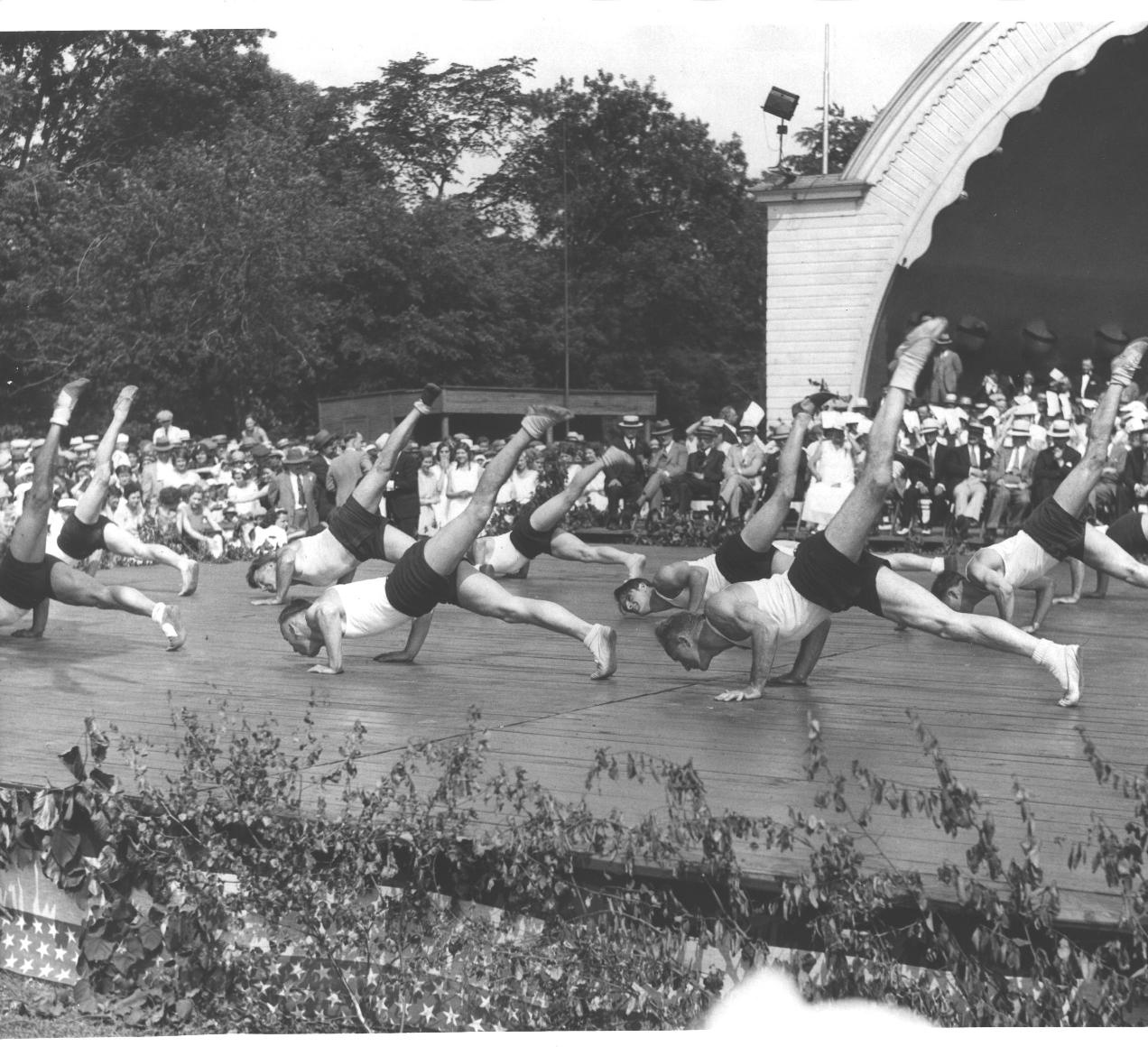
Have you ever heard of Father Jahn? To denizens of the nineteenth century, he was known as the “Father of Physical Education.” His philosophy for good physical fitness included “turnvereins” or physical fitness clubs. Cleveland had a very active one.

Below is a photo of the Cleveland Turnverein, compliments of the Cleveland State University Special Collection. The club is doing a demonstration at Edgewater Park. I’m guessing it was taken in the 1920s.